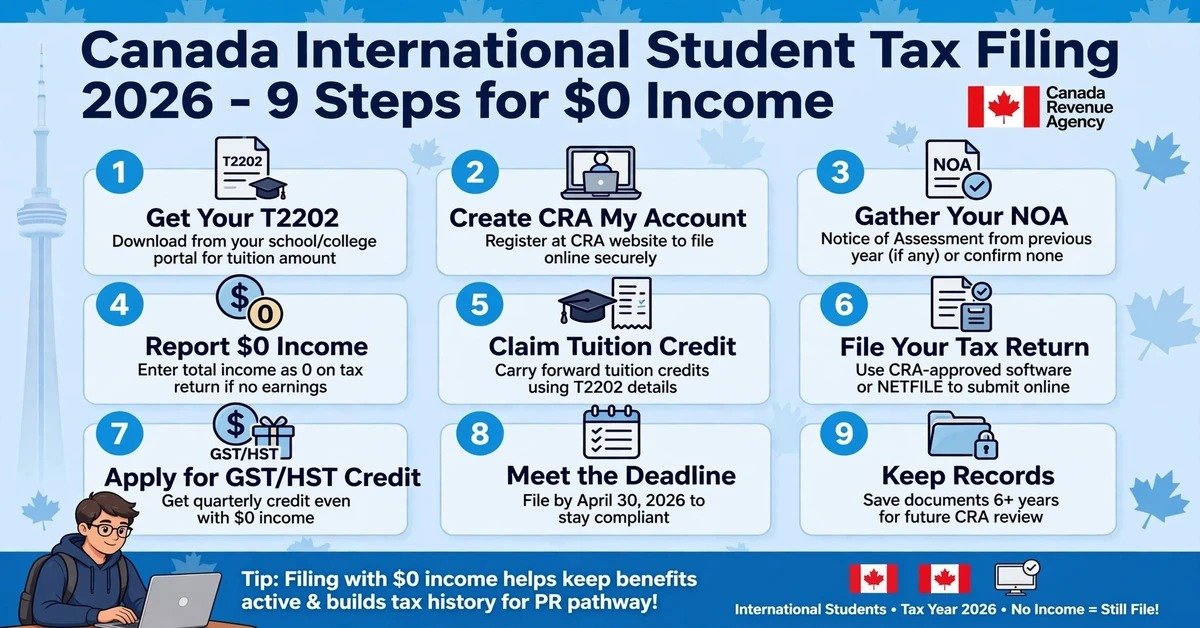
International student tax filing Canada: Should You File With $0 Income?
Do you need to file international student tax filing Canada when you earned nothing? In most cases, yes and it’s worth it.
Filing isn’t just about paying tax. It’s how you record tuition, build a CRA history, and keep your benefits active. Even with $0 income, skipping it can cost you later.
Here’s what most people miss: your T2202 tuition credit carries forward, so filing every year protects future savings.
📌 Key Takeaways
- File even with $0 income if you plan to work in Canada after graduation.
- Your T2202 creates a tuition tax credit you can carry forward to future years.
- Filing builds your CRA record and triggers benefit checks like the Canada Groceries and Essentials Benefit (CGEB).
- Tax residency and immigration status are separate filing doesn’t boost PR points automatically.
The Bottom Line: File Even With $0 Income?
Bottom line: for international students, your tax return is less about writing a cheque and more about protecting future savings.
No income this year means little or no tax to pay. However, tuition records and CRA history still matter. Those carry-forward credits become useful once you start earning, and benefit assessments rely on your filed return.
If you plan to stay and work in Canada, filing annually keeps everything clean.
Why File With $0 Income?
CRA uses your return to track non-refundable credits and assess benefit eligibility. No income doesn’t automatically mean no filing required.
Tuition Tax Credit and Carry-Forward
Your school issues a T2202 (Tuition and Enrolment Certificate). Eligible tuition creates a federal tuition amount you claim on Schedule 11 and line 32300.
With $0 income, you usually can’t use the full credit this year. Good news is, the unused portion can generally be carried forward to future years when you have taxable income.
💡 In short: No income now → limited use this year → unused amount carried forward → use it later when you have tax to offset.
Leaving the record incomplete is rarely the better move if you plan to stay and work in Canada.
Building Your CRA Tax History
Filing also creates your CRA tax history. You’ll get a Notice of Assessment (NOA) and you can track everything in CRA My Account -> https://kcanadatmi.ca/cra-my-account-setup-guide/
⚠️ Important distinction: Filing taxes does not automatically improve immigration points or PR eligibility. Tax residency and immigration status are handled under separate rules by CRA and IRCC.
9 Steps for Your First International Student Tax Filing Canada
Step 1. Confirm Your Tax Residency Status First
Having a study permit does not automatically make you a resident for tax purposes. CRA looks at your residential ties, including:
- A home in Canada
- A spouse or dependants living with you
- Canadian bank accounts, credit cards, driver’s licence, or provincial health coverage
- Length and purpose of your stay
Your residency start date not just your entry date matters. Figure this out before you start anything else
| Status | What You Report |
| Resident for tax purposes | Worldwide income (treaty relief may apply) |
| Non-resident | Canadian-source income only, under different rules |
Step 2. Gather Your SIN and Tax Slips
Collect everything early:
- SIN (Social Insurance Number)
- T2202 the key document for students
- T4 for employment
- T4A for scholarships and bursaries
- T5 for investment income, including bank interest
- Scholarship details and any foreign income records
Your school usually posts the T2202 online download it for the relevant tax year.
| Category | Items to Prepare |
| Income & slips | T2202, T4 / T4A / T5, scholarships, Canadian bank interest, foreign income |
| Personal info | SIN, Canadian address, entry date and residency start date, spouse/dependants |
| Credits & benefits | Tuition tax credit and carry-forward, provincial benefits, CRA My Account access |
Step 3. Check Canadian and Foreign Income
“I didn’t work in Canada” doesn’t always mean zero reportable income. If you’re a resident for tax purposes, you generally need to consider:
- Employment or self-employment income from outside Canada
- Foreign investment or interest income
- Foreign scholarships or research grants
- Foreign rental income
Keep in mind, tax treaties including the Canada-Korea treaty and foreign tax credits can apply, but the starting point is always your residency determination from Step 1.
Step 4. Choose CRA-Certified NETFILE Software
Most students file electronically with NETFILE-certified software. Popular options include Wealthsimple Tax, TurboTax, and H&R Block.
Check free vs. paid features for your situation. As a result, low-income students may qualify for free help through the Community Volunteer
For an official list of certified products, see CRA’s NETFILE-certified software list directly -> https://www.canada.ca/en/revenue-agency/services/e-services/digital-services-individuals/netfile-overview/certified-software-netfile-program.html
Step 5. Complete the T1 Return
This is the standard personal return. Enter your income even if zero plus tuition amounts from the T2202 and other credits.
Have Canadian bank details ready for direct deposit if you expect a refund or benefits.
Step 6. Claim Tuition Correctly and Track Carry-Forward
Enter the eligible amounts from your T2202. The software or Schedule 11 calculates what you can use this year and what carries forward.
Even with $0 tax payable, filing updates CRA’s records so the unused amount is available later. Your NOA and CRA My Account will show the carry-forward balance.
Step 7. Submit via NETFILE
Completing the return in software is not the same as filing it. You must submit through NETFILE and save the confirmation number.
If electronic filing isn’t possible, paper filing remains an option in limited cases.
Step 8. Review Your NOA and Set Up CRA My Account
After processing, CRA sends your Notice of Assessment. Log into CRA My Account to view it, track tuition carry-forward amounts, and manage future filings.
Step 9. Check Federal and Provincial Benefits
Filing lets CRA assess your eligibility for benefits based on income and situation. Examples include:
- Canada Groceries and Essentials Benefit (CGEB) the renamed and enhanced GST/HST credit that started in 2026
- Provincial programs like Ontario Trillium Benefit or BC credits
⚠️ However, students are not automatically entitled to these benefits. Eligibility depends on income, family situation, province, and tax residency the filed return is what triggers the assessment.
Quick Checklist Before You File
- Did you confirm your residency start date?
- Did you download your T2202 for the correct tax year?
- Did you report worldwide income if you’re a resident for tax purposes?
- Did you submit via NETFILE and save the confirmation?
- Did you check your NOA for carry-forward balances?
5 Mistakes to Avoid for International Student Tax Filing Canada
1. Assuming a study permit = tax residency. Residency is based on residential ties like housing, bank accounts, and health coverage, not immigration status.
2. Ignoring foreign income because “I didn’t work in Canada.” If you’re a resident, foreign employment, investment, scholarships, and rental income may still need reporting.
3. Thinking a completed return in software means it’s filed. You must actually submit through NETFILE. A summary screen is not proof.
4. Skipping small T5 bank interest. Even small amounts need to be reported.
5. Assuming scholarships are automatically taxable or exempt. Amounts on a T4A may qualify for the scholarship exemption depending on enrolment status. Check the details rather than assuming.
FAQ
A: You’re not always legally required to file if you have no tax payable and no other triggers. But filing is usually the practical choice to record tuition credits, establish CRA history, and stay in the benefits system.
A: It depends on your Canadian tax residency. Residents generally report worldwide income with treaty relief possible. Non-residents report Canadian-source income only. Confirm residency first.
A: Not always. Amounts on a T4A may qualify for the scholarship exemption depending on your enrolment and the nature of payment. Don’t assume the full amount is taxable — check the details.
Disclaimer: This is for general information only. Please consult a licensed professional or the relevant government agency (CRA, IRCC, or your provincial authority) for your specific situation. Rules and benefit amounts can change — always verify the latest details on the official CRA website.
7. Conclusion / CTA
Bottom line: For international student tax filing Canada, filing with $0 income is about protecting future savings your T2202, your NOA, and your CRA carry-forward all matter once you start earning.
File the return, keep your T2202s, and track the carry-forward in CRA My Account. Future-you with a Canadian job will thank you.