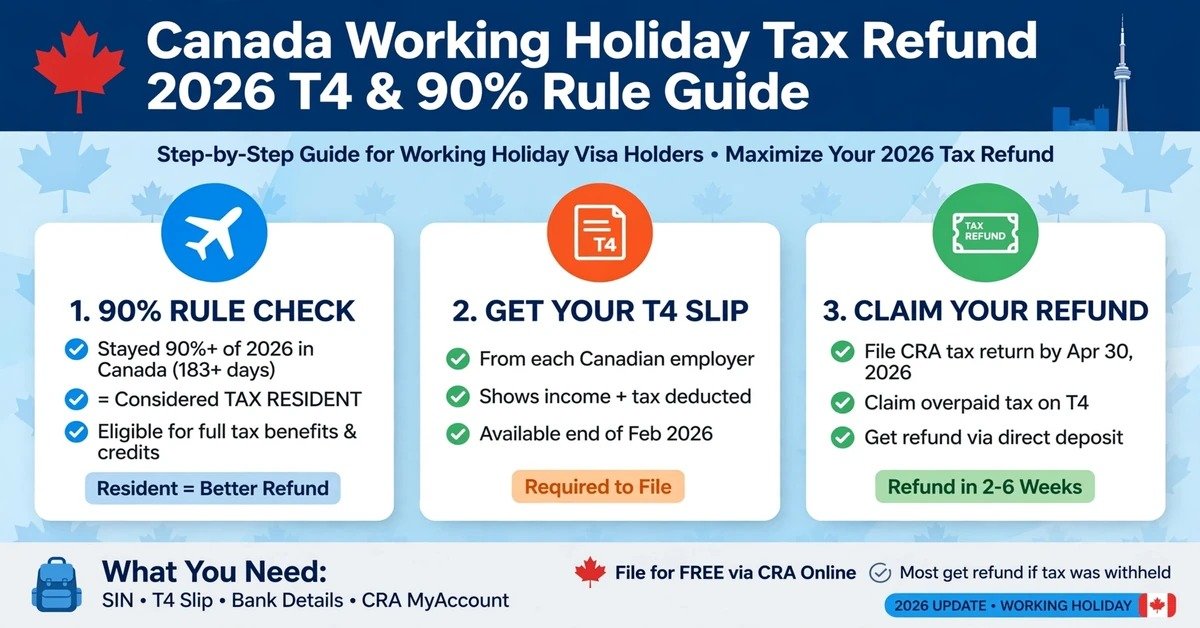
Canada Working Holiday Tax Refund: Start With Residency, Not Your T4
Filing your Canada working holiday tax refund for the first time? Most newcomers look at their T4 first. However, CRA looks at your residency start date first. Your visa type doesn’t decide your refund. Your residential ties do. Here’s how T4s, the 90% Rule, and the 5-step filing process actually work so you don’t leave money on the table
Key Takeaways: The Right Order
Get the order right and you won’t miss anything:
① Confirm your residency start date → ② Sort out Korean income before arrival → ③ Add up every T4 → ④ Check the 90% Rule → ⑤ File via NETFILE.
Why Residency Comes Before Your Refund
Here’s what most people miss: The calculation isn’t the hard part. Figuring out when you became a Canadian tax resident is.
That date decides what counts as taxable income and which credits you can claim.
| Status | What’s Taxed | 90% Rule Impact | Typical Example |
| Non-Resident | Canadian-source income only | Tests your credit eligibility | Korean income before you arrived |
| Resident | Worldwide income | Determines your BPA and credits | Canadian T4 income after arrival |
💡 Important: Your entry date and your residency start date aren’t the same. CRA looks at when you actually set up a home and put down roots, not just when you landed.
How CRA Decides Your Tax Residency
CRA weighs several factors together:
- Whether you have a home in Canada
- Whether your spouse or dependants live with you in Canada
- Whether you have Canadian ties like a bank account, credit card, driver’s licence, or health coverage
- How long you stayed and whether that stay was continuous
If you need to confirm your ties, you can request a residency determination from CRA directly.
Why Your Residency Start Date Matters So Much
Get this date wrong and two things go sideways:
- You might report Korean income earned before arrival as Canadian taxable income.
- Your 90% Rule calculation gets skewed because the non-resident income ratio is off.
In short, this one date changes your entire return.
The 5-Step Canada Working Holiday Tax Filing Process
Step 1: Pin Down Your Residency Start Date
This isn’t your visa issue date. It’s the date you found housing and opened a Canadian bank account after arriving.
Step 2: Collect Your T4s and Supporting Documents
Employers must issue T4s by the end of February. Worked for two employers? You’ll have two T4s.
Checklist:
- Basics: SIN, Canadian arrival date, address, and bank account for direct deposit
- Income: All T4s, plus T4A/T5 if applicable
- Foreign income: Korean withholding tax certificate for income earned before arrival
- Deductions: T2202 for tuition, medical and donation receipts
⚠️ Watch out: Filing with just one T4 when you had two jobs often triggers an automatic CRA reassessment. Log in to CRA My Account to confirm you have every slip. If you don’t have your SIN ready yet, here’s how to apply for and manage your SIN in Canada
Step 3: The 90% Rule and Your Refund
The 90% Rule doesn’t decide if you get a refund. It decides how much of certain credits you can claim.
What the 90% Rule Actually Means
If 90% or more of the income you earned during your non-resident period was Canadian-source, you can claim the full federal Basic Personal Amount (BPA).
| If You Meet the 90% Rule | If You Don’t |
| Full federal BPA available (2025: $16,129) | BPA is prorated or restricted |
| Refund still possible | Refund still possible, but may be smaller |
For official thresholds, see CRA’s page for newcomers to Canada -> https://www.canada.ca/en/revenue-agency/services/tax/international-non-residents/individuals-leaving-entering-canada-non-residents/newcomers-canada-immigrants.html
As of 2026, always confirm the current BPA and CPP/EI limits on the CRA site, since these figures adjust yearly.
Step 4: How Your Refund Gets Calculated
Here’s the simple formula:
Refund = Tax withheld (T4 Box 22) + Excess CPP/EI − Tax owing
- Withheld more than you owe? You get a refund.
- Owe more than was withheld? You’ll have a balance owing.
Worked multiple jobs? If your combined CPP/EI contributions went over the annual maximum ($4,430.10 for CPP / $1,077.48 for EI, 2025 figures), CRA returns the overpayment.
Step 5: File Through CRA-Certified Software
You can file your return using CRA-certified software like Wealthsimple Tax. Most newcomers file for free this way — here’s how free tax filing software works in Canada-> Canada Free Tax Filing Software: Wealthsimple vs TurboTax
4 Mistakes Working Holiday Filers Make
Mistake 1: Visa = Residency. Your visa doesn’t equal tax residency. CRA reviews your residential ties.
Mistake 2: Reporting Korean income as $0. Ignoring pre-arrival income can throw off your 90% Rule calculation.
Mistake 3: Worrying about double taxation. Pre-arrival income isn’t taxed in Canada. CRA only uses it to test credit eligibility.
Mistake 4: Assuming a refund is guaranteed. If too little tax was withheld, you could owe money instead.
Final Checklist Before You Submit
- Did you file through CRA-certified software?
- Did you enter Box 14, 22, 16, and 18 from every T4?
- Did you separate out your pre-arrival Korean income?
- Did you check your residency start date against your housing and banking dates?
FAQ
A: Not automatically. However, if you earned Canadian income and established residential ties, you likely need to file. CRA decides case by case.
A: No. The 90% Rule only affects certain credits. It doesn’t block your refund entirely.
A: Yes, you can estimate from pay stubs if your employer is late. However, it’s safer to amend your return once the actual T4 arrives.
Disclaimer: This is for general information only. Please consult a licensed professional or the relevant government agency for your specific situation.
Conclusion / CTA:
Bottom line: Your Canada working holiday tax refund comes down to three things get your residency start date right, gather every T4, and check the 90% Rule. That’s the whole game.