Got a mortgage pre-approval number that’s way lower than the rate posted on your bank’s website? You’re not imagining things and it’s not a mistake.
That gap comes down to Canada’s mortgage stress test. Lenders don’t qualify you at the rate you’ll actually pay. They qualify you at a higher Qualifying Rate, and that one detail can shrink your borrowing power more than most people expect. Below, we’ll break down how the stress test is calculated and walk through three real borrowing-limit scenarios based on income.
What Is Canada’s Mortgage Stress Test?
Why it exists: Canada’s financial regulators built the stress test to make sure borrowers can still keep up with payments if interest rates climb after closing.
It’s not a one-time rule for a specific type of buyer, either. It applies across the board, no matter how big your down payment is.
- Uninsured mortgages (20%+ down payment) fall under OSFI’s Guideline B-20.
- Insured mortgages (under 20% down) follow the federal government’s mortgage insurance rules, using the same minimum qualifying rate standard.
Bottom line: whether you’re putting down 5% or 35%, every new mortgage application has to clear the stress test.
How the Qualifying Rate Is Calculated
Here’s the catch: your contract rate alone doesn’t account for what could happen to rates down the road. So lenders add a buffer on top of it to stress-test your finances against future increases.
The Qualifying Rate is whichever number is higher between two benchmarks:
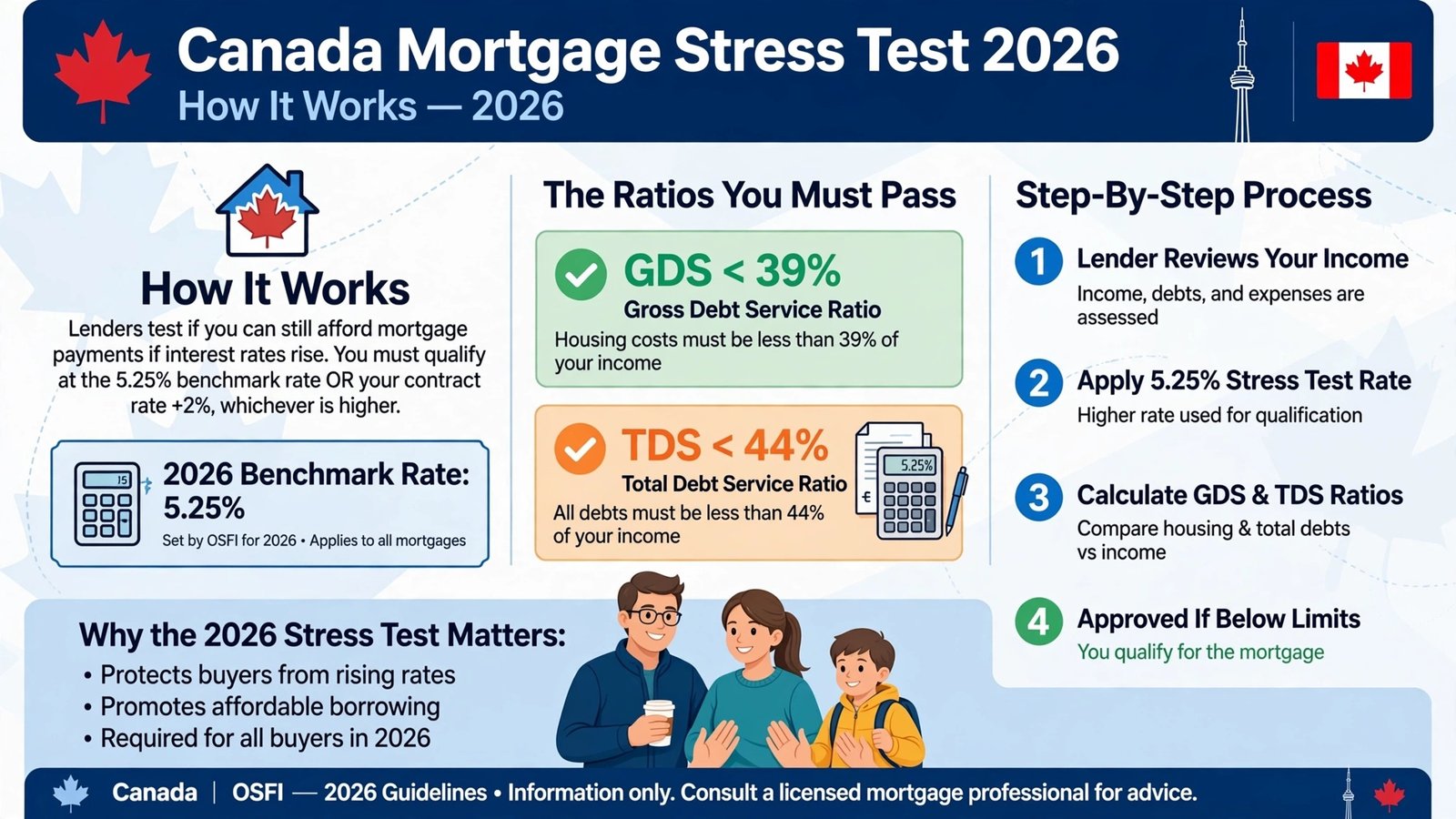
Qualifying Rate = the greater of 5.25% or (your contract rate + 2.00%)
- Contract rate at or under 3.25%? The 5.25% floor applies.
- Contract rate above 3.25%? Add 2%. (A 4.5% contract rate, for example, gets stress-tested at 6.5%.)
One exception worth knowing: renewing your mortgage with a different lender isn’t treated the same as taking out a new loan as long as you’re not increasing the loan amount or extending the amortization.
As of November 21, 2024, OSFI no longer requires the minimum qualifying rate for straight switches of uninsured mortgages between federally regulated lenders, provided the loan amount and remaining amortization stay the same. The same exemption for insured mortgage switches took effect earlier. In short: buying a new home, refinancing, or increasing your loan amount still triggers the stress test a simple renewal switch generally doesn’t.
GDS & TDS: The Formula Behind Your Borrowing Limit
Your borrowing limit isn’t just about the home’s value. Lenders also check how much of your income is already committed to debt, using two ratios: GDS and TDS.
- GDS (Gross Debt Service Ratio): how much of your monthly income goes toward housing costs.
- TDS (Total Debt Service Ratio): your housing costs plus all other monthly debt payments, as a share of income.
Under CMHC’s mortgage insurance guidelines, lenders generally look for GDS at or under 39% and TDS at or under 44%. Keep in mind: if you’re putting 20%+ down on an uninsured mortgage, individual lenders can apply their own underwriting standards so 39% and 44% aren’t hard legal caps in every case.
The GDS and TDS Formulas
GDS = [monthly mortgage payment at the qualifying rate + monthly property tax + monthly heating + (50% × monthly condo fees)] ÷ monthly gross income × 100, must stay at or under 39%
TDS = [everything in GDS + other monthly debt (car loan/lease, minimum credit card payments, student loans, etc.)] ÷ monthly gross income × 100, must stay at or under 44%
Real-World Numbers: 3 Stress Test Scenarios
(All examples assume a 25-year amortization and Canadian mortgage compounding.)
Scenario 1: Single Borrower, No Other Debt
The setup: $90,000/year ($7,500/month), no other debt, $450/month in housing costs, 4.50% contract rate (6.50% qualifying rate).
| Step | Calculation | Result |
| Max housing costs (GDS 39%) | $7,500 × 39% | $2,925/month |
| Mortgage payment room | $2,925 − $450 | $2,475/month |
| Mortgage limit at 6.50% (25 yrs) | Based on $2,475/month | ~$369,500 |
Scenario 2: Dual-Income Couple With a Car Loan and Student Debt (TDS Kicks In)
The setup: $150,000/year ($12,500/month), $900/month in other debt (auto loan + student loans), $700/month in housing costs, 4.20% contract rate (6.20% qualifying rate).
| Step | Calculation | Result |
| GDS-based housing limit (39%) | $12,500 × 39% | $4,875/month |
| TDS-based total debt limit (44%) | $12,500 × 44% | $5,500/month |
| TDS-based housing limit | $5,500 − $900 | $4,600/month (lower than GDS this one applies) |
| Mortgage payment room | $4,600 − $700 | $3,900/month |
| Mortgage limit at 6.20% (25 yrs) | Based on $3,900/month | ~$599,000 |
Here’s what matters: once you add other debt into the picture, TDS is usually the tighter constraint not GDS. If a household carries any other debt, running the TDS numbers isn’t optional.
Scenario 3: Contract Rate vs. Qualifying Rate, Side by Side
The setup: $120,000/year ($10,000/month), no other debt, $500/month in housing costs, 4.00% contract rate (6.00% qualifying rate). Max mortgage payment room (GDS 39%): $3,400/month.
| At Contract Rate (4.00%) | At Qualifying Rate (6.00%) | Difference | |
| Monthly mortgage payment room | $3,400 | $3,400 | |
| Max mortgage (25 yrs) | ~$647,000 | ~$532,000 | ~$115,000 lower (~18%) |
As a result: with the exact same monthly payment room, the qualifying rate which sits 2 percentage points above the contract rate knocks a meaningful chunk off your actual buying power.
Beyond the Stress Test: What Else Affects Approval
The stress test is just one piece of the puzzle. Lenders weigh five factors together when deciding how much to approve:
- Income — salary, self-employment income, bonuses, rental income, and other qualifying sources
- Existing debt — car loans/leases, credit cards, lines of credit, student loans
- Down payment — under 20% (insured) vs. 20%+ (uninsured)
- Credit score — your credit history and how well you’ve managed it
- LTV (Loan-to-Value) — your loan amount relative to the home’s value
FAQ
That’s correct, and it’s by design. The stress test uses whichever is higher between a 5.25% floor and your contract rate plus 2%. For most borrowers today, that works out to roughly 2 percentage points above their actual rate.
Not necessarily. A straight switch same loan amount, same remaining amortization, just moving to a different lender can be exempt from the stress test for both insured and uninsured mortgages. Refinancing or borrowing more, though, still triggers a full reassessment.
Bottom Line
Three things to remember about Canada’s mortgage stress test:
- Your qualifying rate is either your contract rate + 2%, or 5.25% whichever is higher.
- Whichever ratio gives you the lower number, GDS or TDS, is the one that sets your actual limit.
- A simple lender switch at renewal is generally exempt from the stress test.
This guide is based on official OSFI, CMHC, and FCAC guidelines, but the fine print can shift as policy changes. As of 2026, always check the current figures on the official OSFI, CMHC, or FCAC website or talk to a mortgage professional before you apply.
Disclaimer: This is for general information only. Please consult a licensed professional or the relevant government agency for your specific situation.
Sources
- OSFI — Minimum Qualifying Rate for Uninsured Mortgages
- CMHC — Calculating GDS/TDS
- FCAC — Preparing to Get a Mortgage